

To read more, get your copy of The Irish Garden Magazine at your local newsagent
Archives: News
The Galanthus Gala is taking place at Mount Wolseley Hotel, Tullow, Co. Carlow on Saturday 1 February 2020. Ross Barbour, Helen Picton and Catherine Erskine will all be speaking at the event. Tickets are €90, which includes lectures, lunch, admission to a bulb sale, guided tour, afternoon tea and cake at Altamont. If you would like to attend, please contact Hester: hesterforde@gmail.com or Robert: sales@altamontplants.com
Jimi Blake has released his first book on Hunting Brook Gardens, A Beautiful Obsession. For the past 25 years, Blake has been discovering stand out plants for the gardens, which are renowned for exceptional foliage plants, unusual combinations and brilliant use of colour. His fearless experimentation brings surprises around every corner. The book provides ample inspiration for gardening projects.
Visit huntingbrook.com
MoBacter Instant is a natural liquid lawn fertiliser that indirectly destroys moss. This innovative product is iron free, 100% vegetable-based and certified for use in organic horticulture. You’ll see results in just 24 hours. Apply MoBacter Instant directly to moss infested lawns before scarification. It’s advisable to wait until the moss turns brown before scarification. It should be applied between February and November in dry, frost free conditions.
Visit www.nad.ie for more information.
Create a beautiful display of weeping and standard roses in your garden with classic Rose Umbrellas from Owen Chubb. The rose supports are available in two forms for either new and established roses, so they are ideal for both small and large garden displays. They are hand-forged from galvanised steel in the company’s own workshop and are powder coated. All products are made to an exceptional standard and come with a free 10-year no rust guarantee. Prices start at €285. For rose display inspiration, please visit: www.classicgardenelements.ie or call: 087-2306-128.
Pictured: Giverny Rose Umbrella
Sedum Atlantis received the title of Plant of the Year at the 2019 RHS Chelsea Flower Show. Its striking foliage forms rosettes of serrated green, drought-resistant leaves with thick, creamy margins and tips that turn a pink blush in the autumn. Its pink tinged flower buds open to yellow flowers that are magnetic to bees.
The dramatic and versatile garden plant is one of the 40 new varieties now available from Mr Middleton. The Dublin-based garden shop is selling Sedum Atlantis for €8 each, and three for €20.
Visit Mr Middleton Garden Shop, 58 Mary St. Dublin 1 or www.mrmiddleton.com
The Select Controller is the latest addition to Hozelock’s automatic watering range. The controller has 16 different pre-set watering programs that range from four times a day to once a week. Its ‘water now’ button allows for immediate watering, and automatically turns off after an hour. The unit can be used in low light levels to achieve a variety of different programmes. With water saving and sustainability at the top of gardeners’ agendas, the controller can be connected to a rainwater butt tank to control micro irrigation installations as it works at just 0.1 bar.
Visit: www.hozelock.com for more information.
Christmasworld is the festive-decorations sector’s most important order venue. The event will return to Frankfurt in 2020, from 24 to 28 January.
Every year, the event showcases the latest products and trends for all festivities. It generates innovative concepts for decorating large or outdoor areas for wholesale and retail trades, shopping centres, building and DIY markets and green businesses. Over 1,000 exhibitors and 45,300 visitors made their way to Frankfurt am Main for Christmasworld in 2019.
Visit: www.christmasworld.messefrankfurt.com for more information.
CJ Wildlife, the bird food and wildlife care specialist, has released its autumn catalogue. CJs stocks all the essentials; bird-friendly peanut butter, fat balls, peanut cakes, filled coconut shells, suet coated pinecones, mealworms and peanuts. Its husk-free bird food, Hi-Energy No Mess, has been a favourite with customers and birds for 20 year – and it’s currently discounted. CJs feeder range has been designed to suit every bird and every garden. Its Conqueror Feeders are 1.2m tall and hold 3.5kg of food. You can save €8 on its complete Conqueror range this season.
To request your free catalogue today, call 01-539-8442 or visit www.birdfood.ie.
 Welcome to the new Garden.ie Club. We hope you enjoy using it to track the progress of your garden, learn new ways of doing things and meeting like minded people.
Here’s some of the most frequently asked questions and tips:
I was a member of the old club, do my details still work?
Yes! You can login via your old credentials. If you don’t remember them simply press forgot password.
Will my old content be there?
Due to the vast amount of data, it’s not been possible to bring over all the old content. We are making efforts to ensure that the old content be available to anyone who wants to download it. As soon as we have information on this we’ll let you know.
I’m logged in/ registered. What now?
Update your profile (click on about me in the left hand menu) then Introduce yourself and find likeminded people in our group here: https://club.garden.ie/groups/?introduce-yourself-here/
Hashtags #
Don’t forget to end all your posts with hashtags so you can easily find them again. #roses #dublin #gardenieclub etc
Privacy
As with everything on the internet, we urge you to exercise caution when it come to personal details. Please don’t post them publicly. The site also allows great control of your privacy options.
Support
If you encounter any difficulties please email info@garden.ie
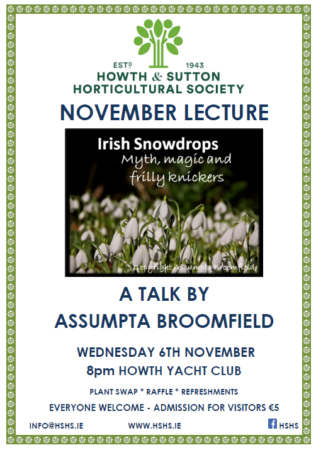
Howth and Sutton Horticultural Society Presents –
“Irish Snowdrops – Myth, magic and frilly knickers” a talk by horticulturist Assumpta Broomfield.
Everyone Welcome! Wednesday, 6th November 2019, 8pm Howth Yacht Club, Howth, Co. Dublin
Plant swap, raffle and refreshments. See www.hshs.ie for further information.
The last few years have seen increasing numbers of natural wild flower explosions as well as purposeful plantations of native species appearing all over the countryside. Both can be seen on roundabouts, along the sides or roads and in fields. I have favourites everywhere, from a particular run of motorway whose steep siding has become alive with orchids since the county council stopped intervening so often. Elsewhere, a dual carriageway siding busy with cowslips has become more populated each year as the clumps set seed on the slope and the wind tunnel sweeps it along. One field of poppies planted in Ballon, County Carlow, spent the summer stopping traffic.
I had a favourite roundabout outside Clonmel which morphed from one flowery display to another from May to November. Most recently, it was shorn to the ground and was beginning to green up again. It will no doubt be a different affair altogether this year. Wild flower meadows are nothing if not ever changing and surprising.
Read the rest of this story in the June issue of The Irish Garden available in your local newsagent or via subscription!
Butterflies are among the wildlife that are most enjoyed. Who has not waved nostalgic, thinking of the good old days when hayfields full of wildflowers were alive with sheets of dancing butterflies in those everlasting summers? What gardener does not welcome the sight of a buddleja bush alive with purple peacock butterflies and rust-coloured, small tortoiseshells? The holly blue in city gardens is one of the first harbingers of spring. Why even the name butterfly, so typically an English word, refers to the arrival of the yellow butter-coloured brimstone butterflies hust when the grass was again growing in May, cattle were producing lots of milk and the butter-making season had begun. Butterflies are a welcome sign of healthy biodiversity.
And yet, butterflies come from caterpillars and alas these are viewed with trepidation by many gardeners and indeed with good reason. The cabbage white butterfly can lay up to a hundred yellow eggs in one go on cabbage plants. These hatch out shortly afterwards, and their first action is to eat the empty shells from which they emerged – commendable recycling – but after that their actions are not considered by some to be so admirable.
Because caterpillars are eating machines, all they do all day is eat. Their mother has, very considerately, laid them on their food plant, in this case your cabbages, and this is what they will dine on. Caterpillars literally eat until they burst. They, unlike us humans, have their hard parts on the outside and as they eat and grow they expand against their unyielding exterior. Something must give, and after a while it is their outside skin that does. They burst up the back, wriggle out of the old skin to feel a lot more comfortable no doubt and proceed to demolish more cabbage. The new stage is called the instar stage and caterpillars have five instar stages in all.
Jane is not a designer given to harsh lines and minimalist planting. She practices what she preaches when it comes to what she makes for herself. From the outset, as they were doing up the house, she began by planting a birch wood. She also started planting hedges. “The garden’s laid out in rooms, using hedges. That was the best thing we ever did. When I design, soft structures are first for me. They give everything else a backdrop. I made the garden in stages. When you work this way, as it grows, you’re ready to manage it. Although one day you go out and see you made a monster!” This I suspect is the way with most gardeners. “It just kept growing…”. Her design method is interesting. She visualises everything from the windows of the house and believes that “You can’t do it from outside.” When the family arrived first, they lived in the basement, and so the areas visible from those basement windows were first to be tackled. Ten years ago, they moved upstairs and so the garden changed. “You’re watching the seasons from the window. Even in winter, you’ll look out at the interest of a cut-down bed. Then you can watch it creep up in the spring.”
We walked out from the front of the house toward the white cherry garden ‘room’, enclosed with walls of beech hedging. “I don’t like pink cherries,” Jane said as we approached. “We put in the grove of five white-flowering cherries and when they flowered, I thought ‘hey, they’re pink!’ They said ‘yes.’ I said ‘no’, so they came and replaced them.” She found that for the first three years, the cherries sat and did nothing. Then suddenly they took off and came into their own, under-planted with a narcissus mix called ‘Floriad.’ There are also tulips and snake’s-head fritillaries, not normally a mix one expects to do well together. Tulips like free-draining soil and fritillaries are happier in more moisture-retentive soil. Yet they are all doing well here. “Jumping out of the soil!” Jane said. Alliums and camassias follow the earlier bulbs, so the bed under her cherries rolls along from early spring to early summer . She cuts it back in mid-June, feeding the ground with chicken manure. Another cut in September sees it into autumn. “Not a lot of work for a whole lot of show.”
When it comes to maintenance, Jane feels that over-maintenance can be as troublesome as neglect. For her, February to May is when the real work is done with the action front-loaded in the early months. “The big tidy up should be done by St Patrick’s Day. Your beds should be so full that by the beginning of June, when it’s all go, there’ll be no room for weeds. From July to August, if there are any weeds, they should be lost among the good stuff. I et people saying ‘You have foxgloves and I have none. Why is that?” It’s usually because they’ve weeded out their foxglove seedlings. Delphiniums and similar plants need to be deadheaded because they put too much energy into seeding, but a lot of other things should be left to set seen. Summer should just be cutting grass and enjoying what you’ve done – and it’s too hot for work!”
Read the rest of this story in your copy of The Irish Garden magazine available in your local newsagent or via subscription!
The Botanic Gardens was founded in 1795 by the Dublin Society (later Royal Dublin Society) as a national institution to aid and promote the study of agriculture and botany. A library essential for this purpose was established four years later and provided apprentices and staff with information to assist and further their work of curating the plants collections. The library at Glasnevin has had various locations throughout its 220-year history.
Although the library was shelved at the time. By 1801, it has been removed to the headquarters of the Dublin Society in Hawkins Street. It later returned to Glasnevin and was located in a lecture theatre and then in one of the gate lodges. Some of the items that would have been in the collection at the time include de Candolle’s Prodromus, Hooker’s Icones plantarum as well as Curtis’s Botanical Magazine and Lindley’s Botanical Reigster. Today we are fortunate to have a library building, desgined by OPW architect, Ciaran O’Connor, was opened in 1997. The library collection in the National Botanic Gardens focuses solely on the subject areas of botany and horticulture. However, the singularity of subject matter is made up for by the variety of format in the collection. It is not only comprised of books but also, of archives, art, photographs and ephemera.
To read more, get your copy of The Irish Garden Magazine at your local newsagent

Classic Garden Elegance at Castle Durrow
Castle Durrow is an elegant 18th century castle situated on 50 acres of estate in Durrow, Co. Laois. Originally the family home of the fiitingly named Flower family, the gardens were designed for the family and their guest to enjoy: the stroll through and admire the beautiful flowers; and for picnics and fashion at the time, and included a monkey puzzle tree and a 12ft tall box plant.
Castle Durrow is now a luxury country house hotel and is owned by the Stokes family. The gardens have been lovingly restored and are as wonderful as ever. Acres of lush lawns, colourful borders, green parkland, a meandering river and plentiful orchards surround the house. The manicured gardens are divided into many rooms with different themes and species of plants in each. At the back of the house guests can find the courtyard, filled with hundreds of fragrant David Austin roses; the walled garden, which includes a picturesque orchard filled with fruit trees; as well as a sunken garden with a canal, ornamental pots and statues.
At the end of a bordered corridor visitors will find the kitchen gardens, where vegetables and herbs are grown, and used by the hotel’s chefs to create wonderful seasonal dishes for guests. Just beyond the kitchen gardens is the recently restored ha-ha – a kind of sunken fence bordered by a wall which was originally designed to provide unobstructed views of the landscape, while keeping unwanted animals out of the more formal gardens.
To read more, get your copy of The Irish Garden Magazine at your local newsagent
The ever-popular and highly successful Carlow Garden Festival, which runs from Saturday July27th to Monday August 5th 2019, is wonderful opportunity for gardening enthusiasts and nature-lovers to obtain inspiration and practical advice from a range of informative workshops while also visiting the many beautiful gardens located in the surrounding area. Featuring 19 celebrated garden experts over 10 days, the festival is sure to interest everyone. The 2019 programme features an appealing mix of top Irish garden broadcasters, writers and designers combined with well-loved UK garden speakers and experts.
With gardens in full bloom and with the majority of gardening work completed, the festival is the ideal time to relax, admire the work of others and make gardening plans for the coming months and year ahead. Visitors can also explore the Carlow Garden Trail which includes great old gardens that have been lovingly restored and maintained throughout the years, and smaller gardens which are maturing beautifully with time. Visitors can enjoy guided tours, usually with the owner of head gardener. Award winning garden centres and forest parks complement the joy of a visit to the Carlow Garden Festival. There is a wealth of interest for the young and old alike!
The Carlow Garden Festival will be opened in Leighlinbridge village on Saturday July 27th by wildlife film maker Colin Stafford Johnson who will lead a nature walk along the River Barrow. In the afternoon he will be in Huntington Castle & Gardens for an illustrated talk featuring stunning film footage and photography from his special wildlife encounters around the world. What a special treat for all nature and plant lovers!
To read more, get your copy of The Irish Garden Magazine at your local newsagent
America may have given us the aeroplane, Bob Dylan and even the Big Mac, but another of its national treasures is the phlox family. All but one of the 60 or so species of this amazing plant family originate in North America and our gardens would be a lot poorer without their floral pageantry that can last from spring until the first frosts of autumn.
Best known and most commonly grown of all the family as forms of the border phlox, Phlox paniculata, a remarkably robust and long-lived perennial with sturdy, waist-high stems that become crowned with a head of flowers in late summer and early autumn. Each beautifully simple flower opens from an elegantly scrolled, point bud and is suffused with a deliciously sweet, yet slightly spicy scent. A large clump in full flower can lace the air with perfume on balmy evenings. Border phloxes are also lovely to use as cut flowers, mixed with roses and alstroemerias for a colourful cottage garden bouquet.
Although phlox are enjoying a surge of popularity at present, their heyday was undoubtedly in the early and middle part of the 20th century. One of the most influential champions of the phlox was English nurseryman Alan Bloom who collected and introduced many outstanding varieties. Some are still around today such as the pale lilac ‘Franz Schubert’, named after his favourite composer, ‘Eva Cullum’ with pink flowers and contrasting red centres and the very beautiful ‘Mother of Pearl’. Alan Bloom also discovered a variegated phlox growing in the garden of Norah Leigh in the 1960s and subsequently named it after the garden’s owner. Its creamy-edged leaves and pale pink flowers with deeper eyes are not to everyone’s taste, but it dos bring a pool of brightness to a shady border.
To read more, get your copy of The Irish Garden Magazine at your local newsagent
Many gardens have a canopy layer of trees, a mid-layer of shrubs and a ground layer community of low-growing herbaceous perennials and bulbs. This ground planting is where the greatest treasures of the garden can be found. For the canopy layer, deciduous trees are best as they allow plenty of light in spring when many plants are beginning to grow and give a gentle dappled shade as the season progresses. It is also easy to remove lower branches to raise the canopy and allow more light to be angled onto the plants beneath. Choose shrubs with equal care, opting for those that do not cast too much shade and include a few evergreen plants as they will give form and structure to the winter garden.
Forget any notion of once-off planting which will serve your purposes forever after. The enthusiastic gardener will continue to interact with the planting, making additions and deletions in the years following the initial plan and planting. No garden is ever ‘finished’, and no gardener would wish it to be finished. Remember that choosing a plant can occur at any time of a plant’s life, because a tree or shrub can be chosen to be retained or for removal. Quite often, the removal of a few over-grown bushes can leave the remaining trees and shrubs looking better, less cluttered with more room for specialist under-story plants.
Now is a good time of year to begin observing the development of the canopy of trees in your own garden, and the effect the canopy can exert on plants that have evolved to grow in open sunshine – namely the transition to woodland. There is even a scientific term for it – natural progression – the process by which different tree species out-compete each until a climax vegetation of durable, long-lived species, notably oak becomes self-sustaining. This natural process occurs in the garden too, not in quite the same way as it can take hundreds of years for climax oak woodland to appear. But it can be seen that parts of the garden become dull and dark with little growth or colour.
To read more, get your copy of The Irish Garden Magazine at your local newsagent

Ninfa has a double claim on this epithet, based on both its horticulture and on its setting in the landscape. Ninfa is the garden of the rose – planted throughout its 8 hectares, it has over 200 varieties and thousands of bushes. However, this reputation for rose-garden romance predates the planting of the garden. set within the crumbling remains of a medieval town, its juxtaposition with wild nature reclaiming the area and negating the puny works of man had great appeal for the romantic poets of the nineteenth century as they travelled through this classical landscape.
Visiting one April, we travelled on the Appian Way in Rome, passing the Colosseum and the Circus Maximus and heading towards Latina, crossing a flat, low-lying agriculture region, once a vast malaria-infested marshland. It is now intensively cultivated to supply the city with fruit and vegetables and is an important kiwifruit growing area. Ninfa is on the edge of the plain, nestled beneath the rugged stone cliffs of the Lepine Mountains where picturesque villages are perched on its peaks.
The undulating hillsides were ablaze with Judas trees in full flower. Regarded as large shrubs or small trees in Ireland, these were towering specimens, reaching to twenty metres in height and with the bare stems covered in cultures of pea-like flowers ranging from light pink to deep magenta. The blossoms originate directly from the branches or trunks as well as from the spurs of the previous season’s growth: a prime example of cauliflory.
To read more, get your copy of The Irish Garden Magazine at your local newsagent
Matter, Motion, Minutes
New works by the acclaimed Irish artist Michael Canning go on exhibition in London on 26 September. Jamie Anderson, director at Waterhouse & Dodd, notes: “Each new exhibition we mount brings a wider audience to Michael’s work and his paintings have proved enduringly popular. I think people respond to the timelessness of the imagery and the beauty of the subject matter. The gallery becomes a rather contemplative space in the presence of his work.” www.waterhousedodd.com
Garden clubs
Balbriggan and District Horticultural Society: Annual Flower Show on 3 September. Exhibits to be staged before 11.30am. Open to the public 2.30pm to 5pm in Balbriggan Community College, Drogheda Street, Balbriggan, Co. Dublin. Admission €3.
Foxrock and District Garden Club: On 26 September, Foxrock Church Pastoral Centre, Rosie Hardy talks on Autumn Flowering Perennials at 8pm. Admission €7 for non-members.
Killinick & District Garden Club: Annual Gardening Show on 9 and 10 September at Johnstown Castle Gardens
in Wexford. Open classes for fruit, flowers, vegetables, herbs and preserves, and others. Show schedules from Jimmy on 087 765 3924
Macroom Flower & Garden Club: Floral Demonstration with Betty Cumiskey AOIFA entitled Gems with Stems, 14 September, at Coolcower House, Macroom, Co. Cork. Doors open 7pm. Further details: 087-9821708.
Visitors are most welcome
Kenmare & District Garden Club: Let’s go Latin – It’s all Greek to Me, Making Plant Names Sexy is a light-hearted and accessible look at the use of botanical names by Carl Wright of Caher Bridge Garden, Co. Clare on 7 September, 7.30 p.m. in The Gateway, Killarney Road, Kenmare. For directions, contact Geraldine 086-3935965.
Ennis Flower and Garden Club: Celebrating its 50th Anniversary, a Floral Demonstration by Brid Coonan, AOIFA President at Treacys West County Hotel, Ennis on Tuesday, 19 September, at 8.15pm. Admission €10 (non members).
Templeogue Horticultural Society: Jimi Blake will talk about New Perennials in Our Lady’s School, Templeogue, Dublin, on 20 September, at 8pm. Admission €7 for non-members. All are welcome.
Waterford Regional Gardening Club: On 21 September, at 8pm, in the Edmund Rice Centre, Barrack St, Waterford.
More Tales from the Road by Shirley Lanigan, gardening writer and author. Non-Members €5. Refreshments & Raffle to follow. Contact Noreen 086-4083419.
Naul Gardening & Flower Club: Annual flower show is on 9 and 10 September in the Clann Mhuire GAA Hall, Naul, Co. Dublin. Open to the public 2.30 to 5.30pm Saturday and 12 noon to 4.30pm Sunday. Auction at close of show, Admission: adults €3, children free. Schedule: 086-2850561.
Galway Flower & Garden Club: On 19 September, at 8pm, in the Menlo Park Hotel, Galway, Beatrice Hartog’s title is A Floral Rendezvous. Admission €10 non-members. Further information contact mariancolohan@gmail.com
It is anticipated that the festival will attract many visitors from far and wide to view the floral exhibitions created not only by renowned national arrangers but also by members of the Parish.
Admission is €10 (which includes teas) and also includes 2 for the price of 1 into Mount Usher Gardens in Ashford village.
For further information contact: Lesley 087 2810478, or Email: ncflowerfestival2017@gmail.com
Weber Spirit E-210 is designed for ease of use and efficient barbecuing. It has a 10-year limited warranty and a number of features to introduce you to barbecuing, such as built-in thermometer, six tool holders and Weber’s Flavorizer Bars. Available from Weber World Store at Orchard, Celbridge.
The Shackleton Gardens at Beech Park, Clonsilla, Dublin, have been transferred into public ownership and Fingal County Council intends restoring the gardens and opening them to the public as an important visitor attraction and tourism asset in Dublin 15. A €415,000 development plan has already been approved and will commence shortly. The Gardens are widely regarded as being internationally significant.
Powerscourt Estate had record visitors as 467,000 guests visited Powerscourt Gardens and Waterfall over the past 12 months, a 14% increase. 271,000 people visited Powerscourt Gardens, up +9% over the previous year. Powerscourt Estate is the 9th most popular tourism destination in Ireland, according to Failte Ireland. Visitors from Ireland to Powerscourt Gardens were up by 34% while visitors from China grew by 47%, the third-most important group.