

Post category: List of garden pests
The capsids are both friend and foe! Most types of capsid bug are beneficial predators, especially in fruit trees. However, a few species cause damage to plants. Apples can have rough patches and bumps due to capsids feeding on the developing fruit but this is rarely significant.
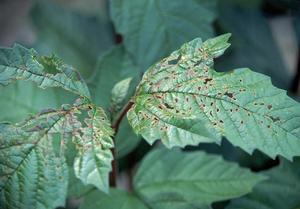
Capsid bug damage
Dahlias, asters, and shrubs such as viburnum and choisya are often damaged quite seriously by capsids feeding on the shoot tips as they emerge – the damage only becoming apparent later on when it is to late to control the pest. Either grow something else or, in a heavy infestation, spray in May with general garden insecticide.
Damage is done by the root fly grubs as they feed on the roots of cabbage family plants, including radish and turnip. Wallflowers and cleome can also be attacked. Sometimes in a wet season, the sprouts of brussels sprouts can be attacked as well as the roots.
When the small white grubs reach 1 centimetre, they pupate in the soil, emerging as adults after a few weeks, or else the following spring. The adults are like houseflies and can be seen hovering around young cabbage plants prior to laying eggs in the soil.
If the attack comes early in the life of the plant, it is usually severely stunted and killed by wilting in a hot spell. The main roots will have been destroyed. If the plant is fairly big when attacked, it often grows on after the initial check.
Early digging and the removal of old crops are important in reducing the numbers of adult flies that emerge. However, they can fly considerable distances, so others will appear. Discs or squares of polythene, about 15 to 20 centimetres across, can be placed around the stem of the plants at planting out to prevent egg-laying. A slit is make halfway across so as to fit snugly around the stem of the plant as this the key point of attack. Overlap the slit, so there is no gap and no access to the soil.
Many different bird species can cause damage to plants. Fruit and vegetables are the main targets, being good food sources. Pigeons are major pests of all cabbage family plants, peas, raspberries, gooseberries and blackcurrants. Crows attack peas in rural areas. Bullfinches and sparrows strip out the buds of fruit trees and bushes.

Cauliflower damaged by pigeons
Blackbirds, thrushes and redwings eat strawberries, cherries, apples, pears and any sort of red berries such as cotoneaster, mountain ash and pyracantha. Starlings eat cherries and, along with crows, commonly peck at lawns to get leather jacket grubs but this is at least as beneficial as it is damaging.
Netting is the most effective solution to bird damage. Crops are only vulnerable for a part of the year and can be netted at those times. Damage to cabbage family plants usually ceases when they are about 20 centimetres tall because the birds cannot see over the plants, but if they are hungry enough, damage will continue.
Scaring devices such as strips of foil or plastic work quite well, but the birds can get used to them eventually.
A major pest of plants, both indoor and outdoor, greenflies can be black, brownish, reddish or blue as well as green. There is a specific type of greenflies for nearly every kind of plant, and some species have a wider range of hosts. Weakening plants by sucking out the sap, greenflies are also the main distributors of virus diseases. Unsightly, black sooty moulds often grow on the honeydew excreted by greenflies, and wasps may come to feed outdoors.

Curled apple leaves caused by greenflies
There is a limited number of plants that are frequently badly affected and need to be sprayed for greenflies. These are mostly fruit and vegetable crops and include strawberries, raspberries, apples, plums, weeping birch, japanese maple, blackcurrants, gooseberries, lettuce, beans, cabbage, brussels sprouts, roses, honeysuckle, any greenhouse or indoor plant, and herbs.
A kind of greenflies – woolly aphids – produces woolly masses on the branches of apples and pyracantha and severely weakens the plant, causing it to lose leaves and grow poorly. Control is usually necessary.
Greenflies have many natural enemies, both predators and parasites, and very often these can be left to control the greenfly population. Leaves and shoots often curl up when infested, the greenflies usually feeding within the protection provided. Even on the commonly affected plants, the natural control systems need to be supplemented only when populations look like building up early in the summer.
Controlling the first attack is usually enough to return to balance. The best product to use is Rapid, because it kills only greenflies and not the natural predators. Other products that can be used are non-persistent chemicals like Derris and Malalthion.
Systemic insecticides, which enter the plant sap, are used where the leaves are rolled up and the greenflies are safely hidden.
Soap solutions are quite effective against greenflies, and not harmful to predators. Hosing greenflies off with a jet of water can be tried too. Winter wash, with tar-oil, is effective against greenfly eggs on fruit trees, but is harmful to predators.
The adult vine weevil – a dark brown round-backed beetle-like insect – eats U-shaped pieces from the edge of leaves of shrubs, especially rhododendron, bergenia, euonymus and pieris, earning it the nickname of ‘ticket collector’. This damage, usually near the ground, is not significant but it is an indication of the presence of the pest.
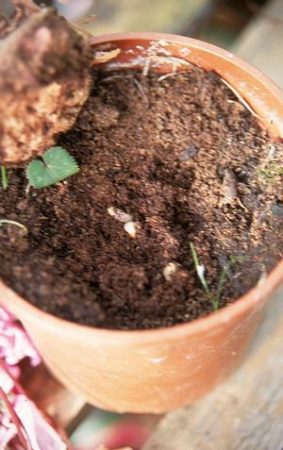
Vine weevil larvae on cyclamen
Where there are signs of adult damage, the chances are that the white, C-shaped grubs are active below soil level. These cause severe damage by eating the roots of many kinds of plant, especially fleshy-rooted plants.
Rhododendron, strawberries, grapes, cyclamen, primula, begonia, sempervivums, saxifrages, camellias and potted plants are commonly affected. The damage to woody plants occurs usually at the neck of the plant where the bark is eaten away.
Vine weevils are more active in the warm soil of pots and greenhouses. Virtually unknown twenty five years ago, they have been spread to gardens in plant pots. Affected plants show poor growth and often wilt, though well supplied with moisture, before dying.
Damage is usually most severe when plants are grown in pots filled with peat based compost and when peat is used in the planting hole outdoors. Mixing unsterilised garden soil, half and half, with peat-based compost greatly reduces the numbers of grubs in pots because it introduces the natural predators and parasites of the vine weevil eggs and grubs. Always thoroughly mix peat with the garden soil outdoors for the same reason.
Check the roots of new plants for grubs. Clear all debris to reduce hiding places for the flightless, nocturnal-feeding, adult weevils. Provado is effective used in the compost.
Parasitic eelworms are available on order from garden centres and by post. These attack the grubs, but there must be a low level population of grubs already present before application and soil temperature levels must be at least 12º Celsius, which is common in a greenhouse but reached outdoors only in the summer months. The eelworm remedy is best applied in late July or August.