

Post category: Streams and Waterfalls
Although it is possible to approximate to a natural stream by creating a long, narrow, shallow pool with a circulating pump maintaining some movement at narrow points, it is impossible to make a sizeable artificial stream without incurring large electricity bills!

Streams and Waterfalls
Click here to view bigger sized image
A small garden stream, or rill, can be artificially built and need not cost much to run because the volume of water is quite small. If the stream bed is terraced to hold the water on the slope, the stream will appear more substantial and its little waterfalls are a feature in themselves.
Many gardens have a natural stream, but relatively few make good use of them. Streams with steep banks are usually ignored for garden purposes because of the danger and are often fenced off, but a natural stream can be a great asset.
A path cut into the bank down by the water’s edge, or built out from it, makes a stream much safer. It also makes a garden feature of it. A stream should be left partly open, partly planted along its banks. The steepest, most dangerous parts can be planted.
Waterfalls
The level of the bed of fast-flowing streams falls quickly over a relatively short distance. In the same way that sloping dry land can be terraced, the bed of fast streams can be ‘terraced’ by building a wall across and filling behind it with rock.
Streams and Waterfalls
Click here to view bigger sized image
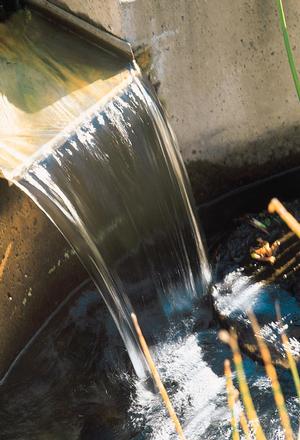
If the water flows down across its full width, it is a weir. If it crashes straight down in just one place, it is a waterfall. Though unusual as garden features, they are very spectacular.
An artificial waterfall that needs a lot of water is expensive to install and to run. A small flow of water can be good if it is nicely built. Whether large or small, there is one very important point to bear in mind. Water should not fall from the highest point of the structure. In nature, water never falls from the highest point. To have it do so, spoils the whole effect.
Bridges and stepping stones
Bridges have the practical function of crossing water, but they have ornamental value as well. Simple, or very elaborate, bridges can be made of timber, stone, concrete or metal. Stepping stones are the most basic form of ‘bridge’ and they are very decorative used with a stream or pond.