

Post category: Town Gardens
Assessment
Medium height walls, garden faces south.
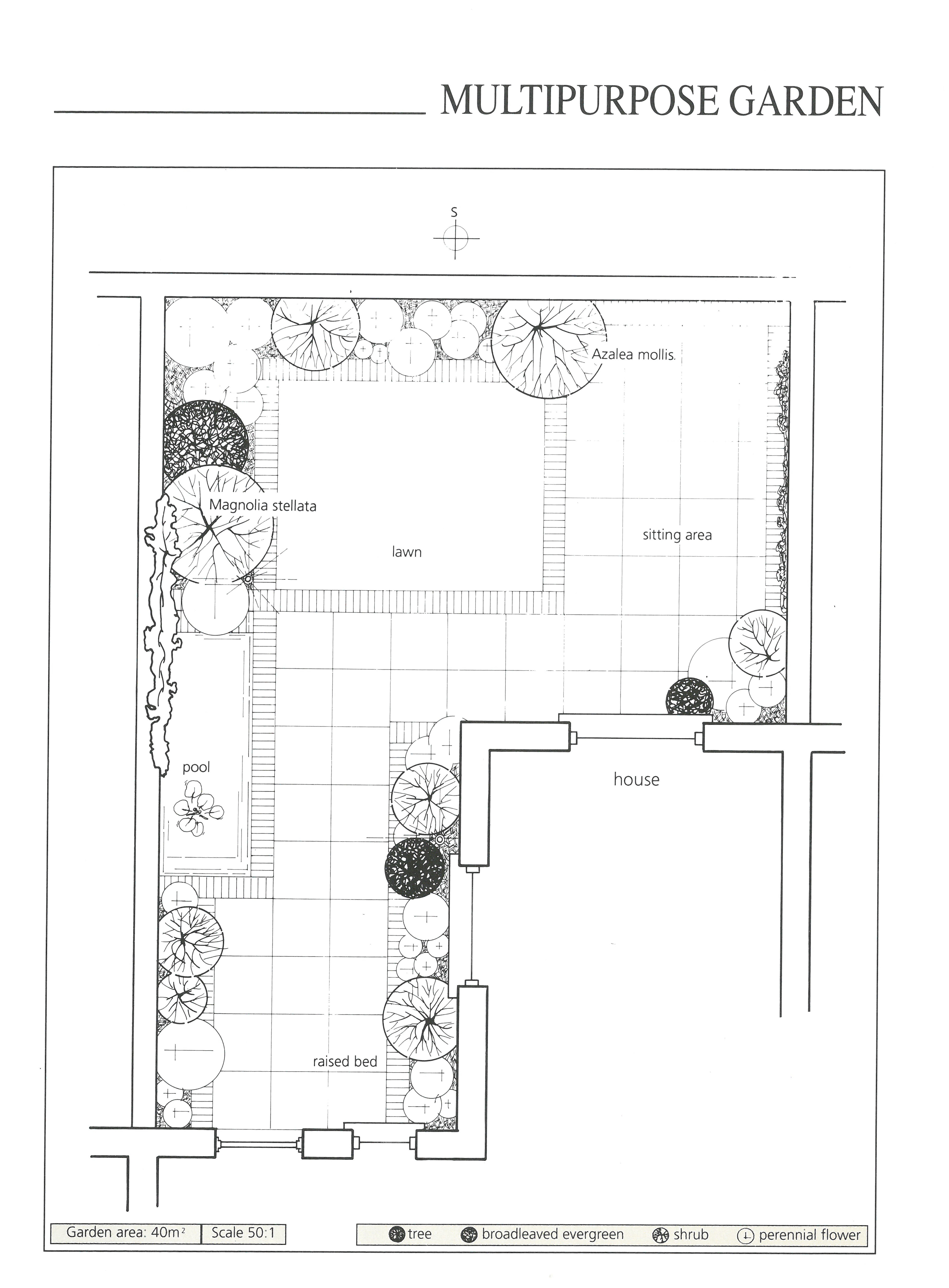
Scanner Q76
Case Study No. 7
Click here to view bigger sized drawing
Hard landscaping:
Most of the surface is paved with 60 cm square grey or buff concrete slabs edged with red bricks laid on their edge. An area of ground for a lawn is edged all round with brick to provide a mowing strip. A rectangular pool is also edged with brick.
The same bricks make up the edges of a number of beds and borders. These are all at the level of the lawn and paving except those on either side of the back door, which are raised by fifteen centimetres. Lamps are placed near the pool for reflections at night.
Planting:
Although most town gardens are best paved to resist wear and tear, many people like to have a small patch of lawn. A mixture of shrubs, some broadleaved evergreens, and perennial flowers are used in the beds and borders to contrast with the even surface, and colours, of lawn and paving. There are some climbers on the walls.
Garden style:
A traditional semi-formal style with rectangular shapes strengthened by the use of brick edging. The pool would need to be made of concrete to ensure a solid foundation for the brick edging. This garden would be suitable for children if the pool was used as a sandbox. The lawn could be taken out and paved if it became a bother.
Maintenance and cost:
Some maintenance required, lawn to be cut. Relatively inexpensive garden, cheap paving. The pool and lighting would add to the cost.
Assessment
Medium height walls, garden faces south, most space to the side of the house but it is overlooked.

Scanner Q76
Case Study No. 6
Click here to view bigger sized drawing
Hard landscaping:
Most of the surface area is covered with coarse sand to a depth of at least seven centimetres. Part of the area is paved with 40 cm square concrete slabs and forty by 60 cm square slabs in alternating, staggered courses. The paving could be grey, brown, red or buff in colour to suit the sand and stones.
Groups of large and small stones are used to contrast with the fine texture of the sand. A drilled stone with a trickle fountain features at the centre of one of the groups of stone. This would have a catchment pump and circulation pump.
A pergola of stained, or painted boards (25 x 5 cm) set thirty centimetres apart provides screening from being overlooked. It does not cover the south-facing part of the paved area. Lamps are located near two groups of stones to highlight them at night.
Planting:
Very few plants are used. There is a climber on the pergola and house wall. A handful of shrubs and perennial flowers of dramatic shape and foliage provide contrast with the texture of stone, sand and paving.
Garden style:
A very informal style, the emphasis is on the shape and texture of hard materials and plants.
Maintenance and cost:
Almost maintenance-free, occasional raking. Relatively inexpensive; not much paving. Pump, pergola and lights would add to the cost.
Assessment:
High walls surround the garden. Faces east, overlooked from the northwest.
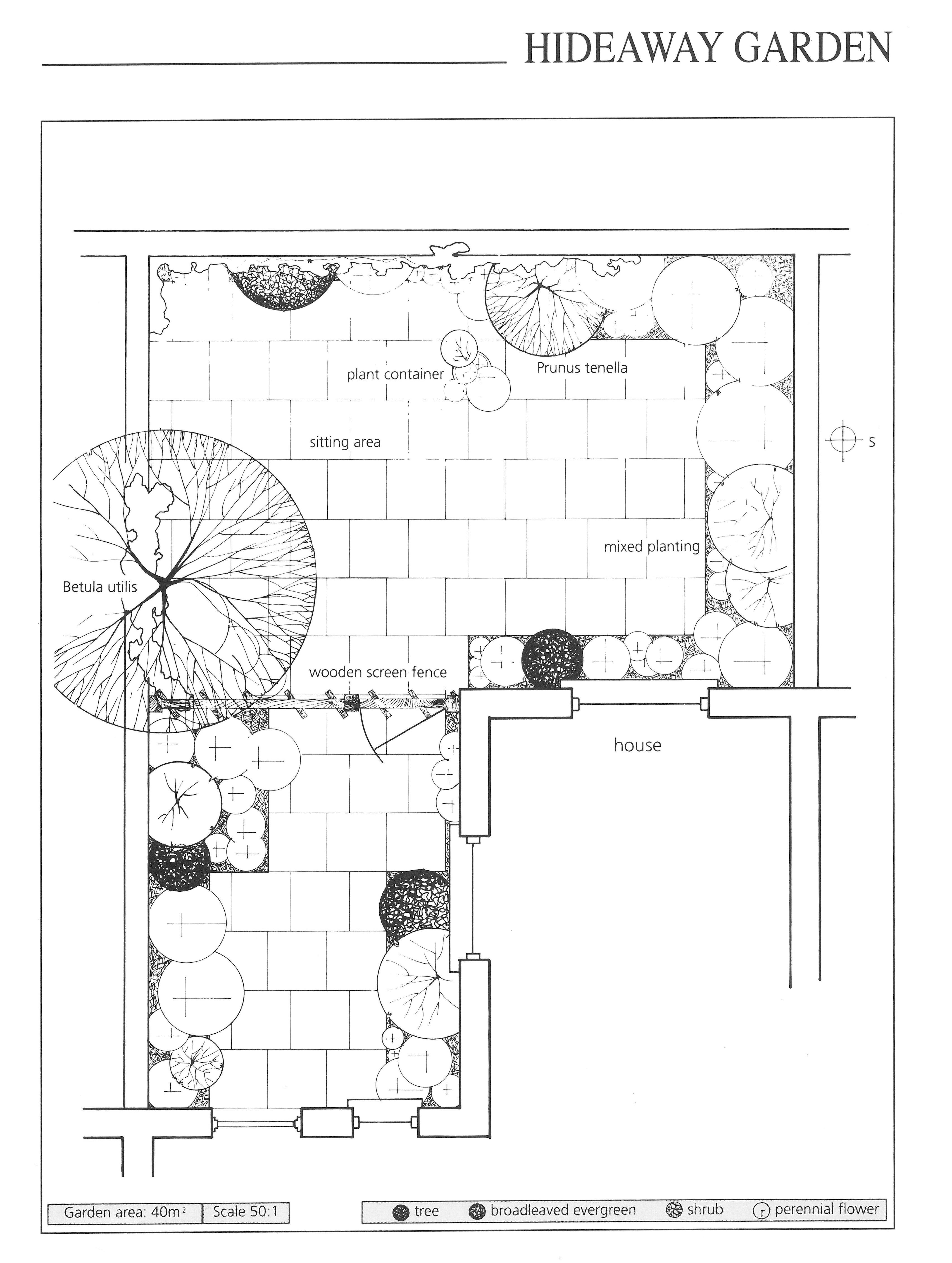
Scanner Q76
Case Study No. 5
Click here to view bigger sized drawing
Hard landscaping:
The garden surface is paved with 60 cm square concrete paving slabs laid square in staggered courses. A generous border is left around the walls except beside the sitting area. An open screen fence of dark stained, or black painted, boards (25 x 5 cm) divides the garden to the height of the walls. It has a doorway.
The screen fence cuts off the view from the northwest but it is angled to allow a view of the garden from the small window. One wide, low concrete container provides ornamental interest on the paved area.
Planting:
A small standard tree (3 metre spread of branches) provides screening from a higher level, complementing the wooden screen. A mixture of shrubs and perennial flowers fills the borders and, in some cases, spills out onto the paving to soften its hardness. Climbers decorate the walls and, by being taller, the tree helps to ‘reduce’ their height.
Garden style:
An informal style, there are no strong geometric shapes. The paving forms a strong, but informal, pattern, and its flatness emphasises space. Suitable for children.
Maintenance and cost:
Easily maintained; occasional tidying. Inexpensive; cheap paving, wooden fence. No pool or ornaments, except one container.
Assessment:
Medium height boundary walls, garden faces south, overlooked from the east.

Scanner Q76
Case Study No. 4
Click here to view bigger sized drawing
Hard landscaping:
The garden surface is laid down to gravel with 60 cm square concrete paving slabs set into it to make a small paved sitting area and a path. A raised (30 cm) bed on the south side of the garden lifts plants to the light and provides drainage. A narrow bed around the base of the house walls links the house to the garden.
Two stone troughs can be seen from the windows. An open screen fence of white painted boards (15 x 2.5 cm) on top of the wall provides effective screening without excluding light. Lamps would give dramatic night-time effects.
Planting:
Plants that prefer dry conditions because the garden is warm and sunny. The sunniest position is given to the plants; the paved area being moved into the shadow of the end wall. Shrubs and perennial flowers of Mediterranean origin are used around the walls, alpine plants in the raised bed and narrow bed. There are alpines in the troughs and also planted through the layer of gravel and allowed to spread over it.
Garden style:
An informal style using hard materials of informal shape and plants to set them off. Some plants of strong shape, for example spiky types, would set off the gravel.
Maintenance and cost:
Easily maintained; occasional watering. Relatively inexpensive; gravel is cheap, but real stone troughs and lighting would add to the cost.
Assessment:
High boundary walls on all sides, garden faces west.
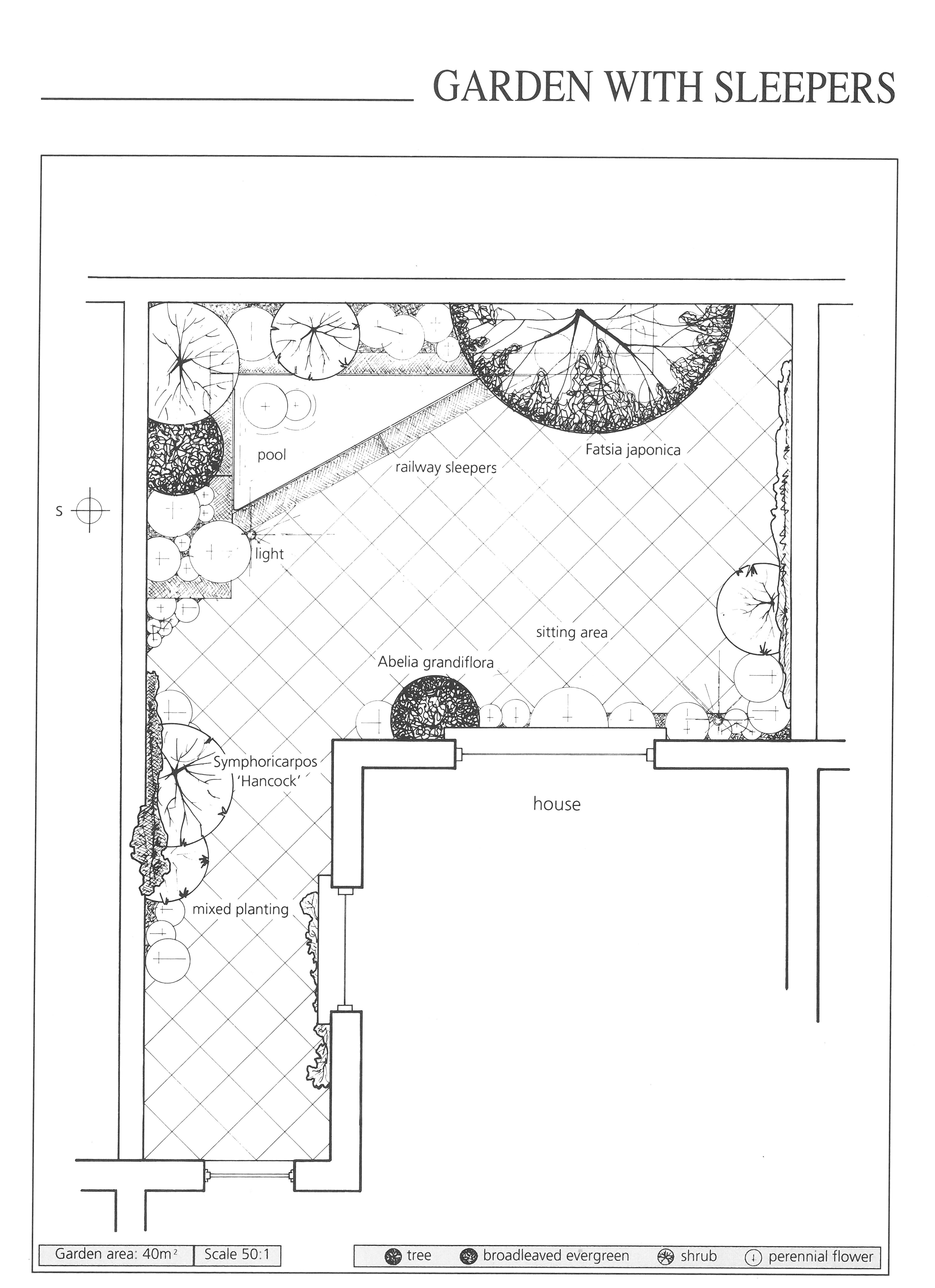
Scanner Q76
Case Study No. 3
Click here to view bigger sized drawing
Hard landscaping:
The entire area of the garden is paved with 40 cm square concrete slabs laid diamond pattern. The concrete slabs could be grey, red or yellowish in colour. A narrow bed beneath the large window links the house with the garden, and a second one provides interest from the small window.
The shaded corner has a raised (20 cm) pool made of railway sleepers, two high, and a raised bed at the back, four sleepers high. The pool is lined with butyl rubber, taking its shape from the sleepers. There are low level bollard-style lamps to light the garden at night.
Planting:
The plants in the shaded part are shade-tolerant, broadleaved evergreen shrubs and ferns. The ornamental beds have some shrubs, perennial flowers and provide rooting for the wall climbers. One broadleaved evergreen tree provides a counterbalance to the strength of the sleepers. Plants should be mostly green.
Garden style:
A semi-formal style with strong rectangular and triangular shapes provided by the sleepers. They also provide strong texture and dark colour. Paving could be grey or reddish, toned down by the dark evergreens.
Maintenance and cost:
Easily maintained; occasional tidying. Not expensive; cheap concrete slabs and sleepers, lighting would add expense.
Assessment:
High walls on all sides, garden faces south.

Scanner Q76
Case Study No. 2
Click here to view bigger sized drawing
Hard landscaping:
The entire area is paved with thirty centimetre quarry tiles to create a feeling of space. There is an ornamental pool that is edged with quarry tiles and a border on two sides of the pool. This is raised about ten centimetres above the level of the paving and pool edge.
Roughly twenty five clay pots of various sizes are used for their own ornamental value and to hold plants. The corner opposite the pool has been left unpaved as a small corner bed.
Planting:
A variety of shrubs, perennial flowers and some bedding plants are used to soften the flatness and uniformity of the tiles. Most of the planting is permanent but some of the potted plants and the bedding plants will be replaced twice each year.
The potted plants are used in groups to set each other off – shrubs and perennial flowers for permanent shape, annuals for colour. There are some climbers on the walls.
Garden style:
A semi-formal style using diamond pattern paving, a rectangular pool and circular pot shapes. This would be quite plain without the informality of the groupings of pots. The pool is partly obscured by a grouping of pots.
Maintenance and cost:
Considerable maintenance; watering pots. Relatively expensive; tiles and formal pool would be best made of concrete, which is costly.
Assessment
High boundary walls (2m) all around, garden faces south.
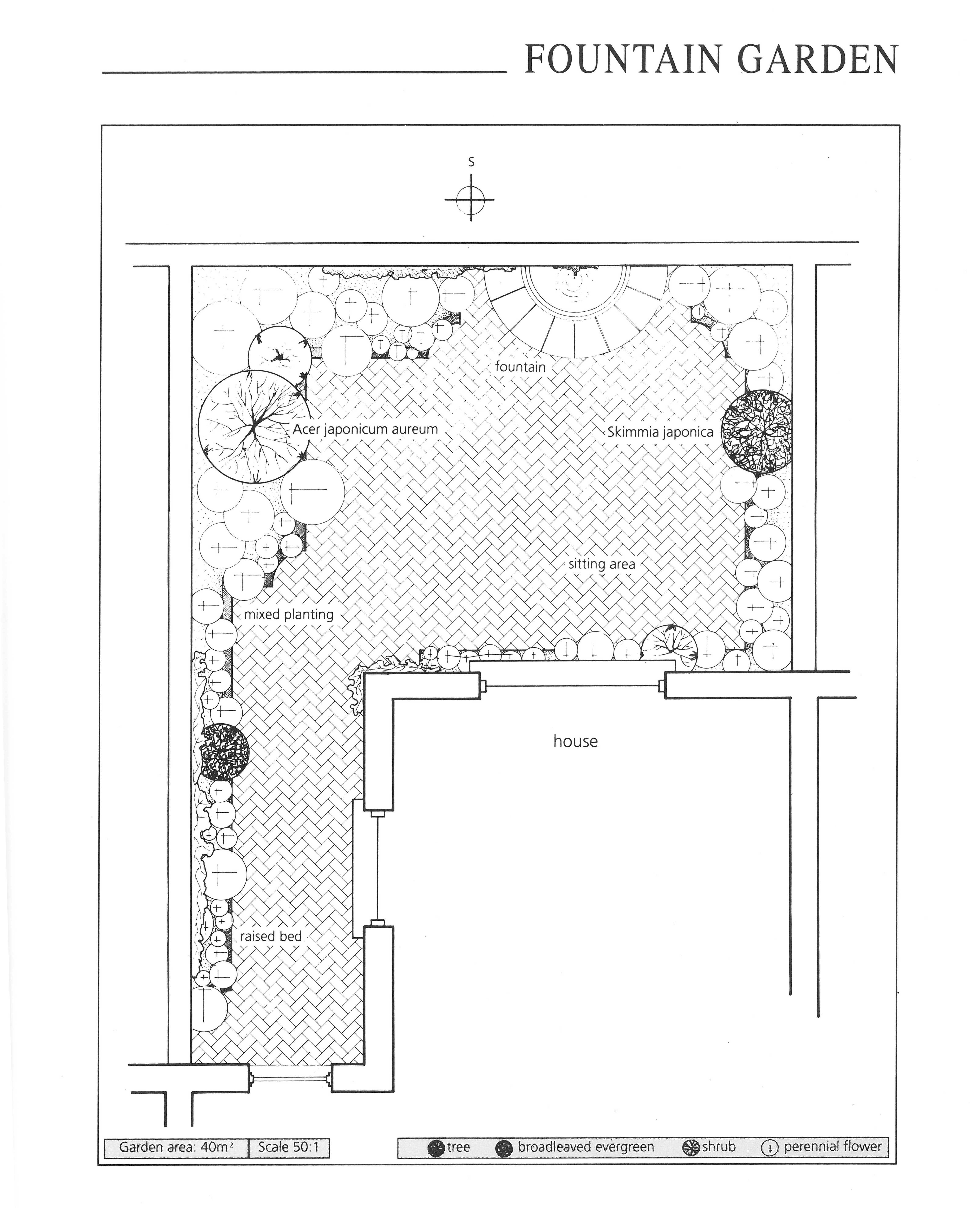
Case Study No. 1
Click here to view bigger sized drawing
Hard landscaping:
The entire surface area is covered with concrete paving bricks except for borders that run around most of the length of walls. The borders are edged with an ornamental raised (10cm) coping that is curved at the corners.
There is a curved basin and wall fountain. The coping and basin surround could be of grey or buff concrete, or natural stone cut to shape. A small circulating pump could be installed in the bottom of the basin.
Planting:
The plants are mainly perennial flowers with some ferns in the shade of the walls to soften the formality of the hard materials. A few shrubs, including a couple of broadleaved evergreens, give the planting some permanence for the dormant season. Some climbers should be used to soften the walls and make use of the vertical space.
Garden style:
A formal style with the use of formal circles in the border edges and the water feature. The basin fountain cannot be seen until the corner is turned. Because of their small size, paving bricks create an impression of greater space, as does the herringbone pattern.
Maintenance and cost:
Easily maintained; needing only occasional tidying. This would be reasonably expensive because of the amount and type of paving, and the ornamental basin.